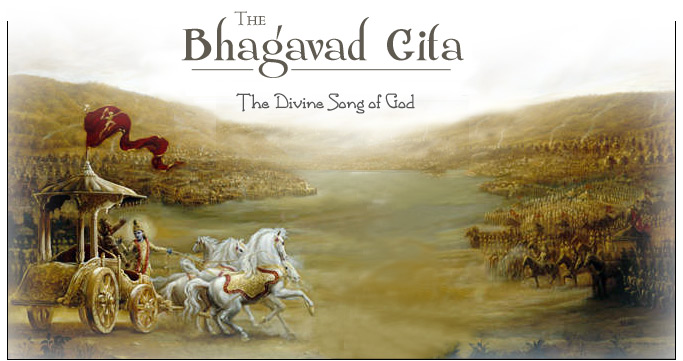
The Bhagavad-Gita is a Hindu Epic poem written by Veda (Dwaipayana) Vyasa. This Epic is an excellent way to learn about Hinduism. A major theme in the Bhagavad-Gita is the renouncement of all desires in order to best serve one’s Dharma, which is one’s specific purpose in life. For Arjuma, the main character, his Dharma is to be a warrior. The bulk of the poem involves Krishna (God) convincing Arjuma to be loyal to his Dharma and to fight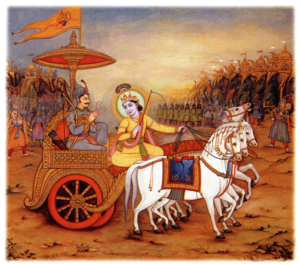 in the battle that is going on when the Epic begins. Arjuma, however, does not want to fight because his family members are fighting for the opposing side and he doesn’t want to kill them. Arjuma knows that causing harm to one’s family brings bad Karma and he believes that it will be worse to kill his family and friends than to deny his Dharma. Therefore, Arjuma decides to do nothing. Krishna then explains many Hindu virtues to Arjuma in great detail, including the importance of renouncing one’s desires.
“Set thy heart upon thy work, but never on its reward.”
― Krishna (Dwaipayana (Veda) Vyasa)
Krishna explains that harboring any desires, good or bad, is going against the Hindu practices and that all earthly desires must be renounced. He explains that even Arjuma’s good intentions toward his family are harmful because he is betraying his purpose in life. This will bring him bad Karma. He also explains that Arjuma should not be saddened by the death of anyone because everyone will be reborn after the death in this particular life. The Epic ends with Arjuma’s decision to live for his Dharma and fight in the battle, gaining full understanding of the Hindu values and teachings.
This Epic is important for future writers to read because it is important for writers to be well versed in other cultures and religions. Being knowledgeable about other cultures and their beliefs will help writers gain a better understanding of their own culture. It is also especially important for those that will need to incorporate some Hindu teachings and beliefs into their writing in the future such as, reporters and journalists of foreign affairs. For high school teachers, because this subject is a bit tricky in terms of all the different names for the Gods, I would recommend teaching some of the most important names 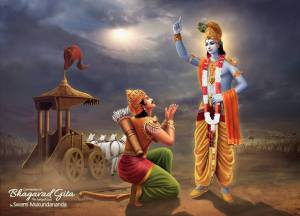 through a fun game like Jeopardy. For students one of the most difficult aspects of Hinduism and its literature can be the plethora of names for the Gods, such as Krishna, Vishnu, Braman, and so on. Of course, it is impossible to learn all the names of all the Gods, but it can be helpful to know the names of the Gods in the specific piece you are teaching. In order to do this in a fun and engaging way you can have your students get into groups and play against each other in Jeopardy. The winning group could be rewarded with a few extra credit points that will be applied to their next test. For a more modern flair you could use the show “Hoarders” to showcase one of the virtues in Hinduism. That is, getting rid of or cleansing oneself of earthly desires. Of course, the show does not involve the full extent of renouncing all desires, but the participants do have to purge themselves of their greatest desires, hoarding some kind of possession. For some of them it’s collecting phone books, for others it’s as seen on TV products.
 Pen-Ultimate
Leave a comment